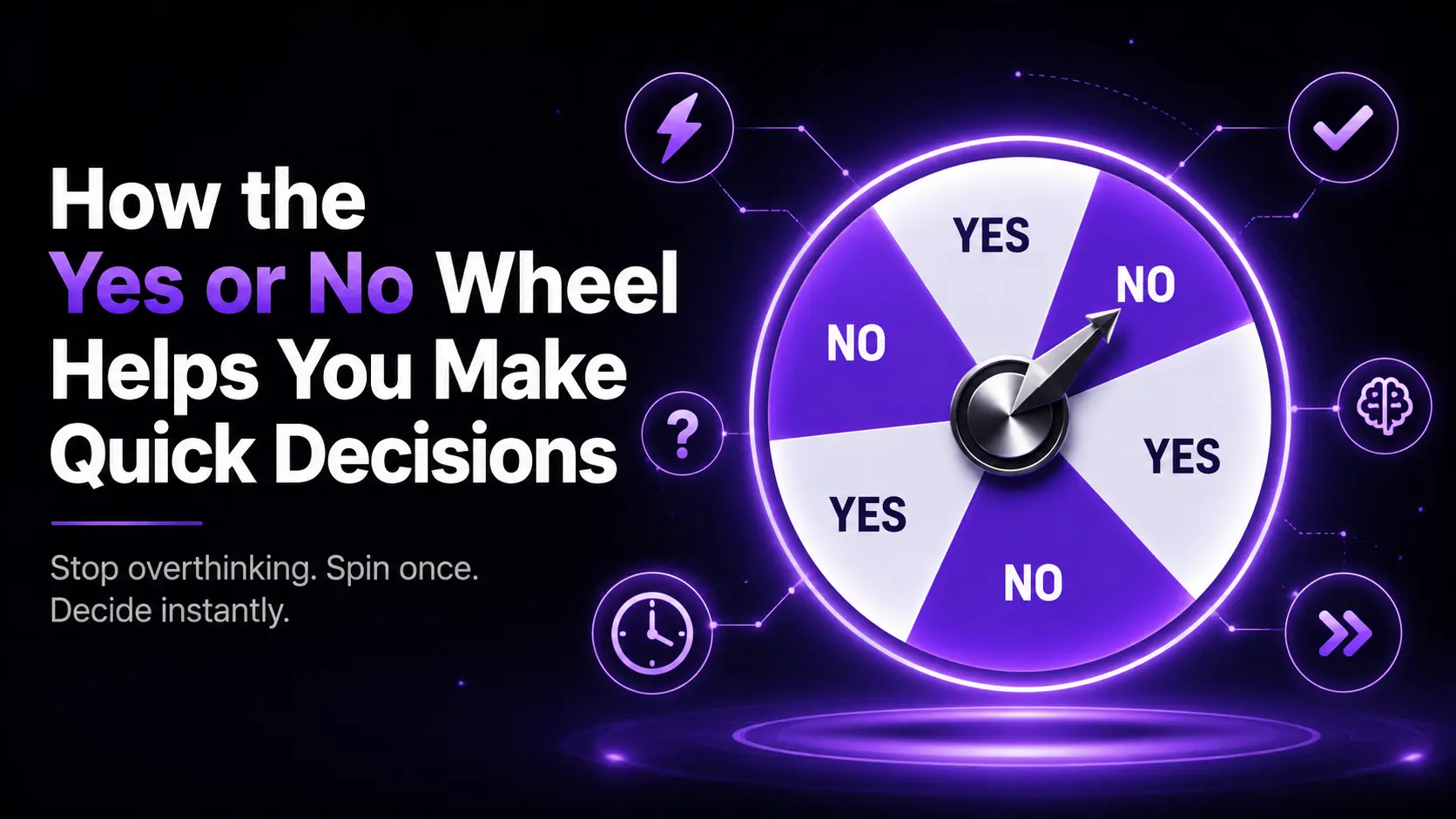
How the Yes or No Wheel Helps You Make Quick Decisions
You’ve had two browser tabs open for twenty minutes. One says “book the trip.” The other says “close this and think about it later.” Nothing about the decision has changed since you opened them. You’re not missing information. You’re just stuck, running the same two thoughts on a loop, and every minute you spend on it makes it feel more important than it actually is.
That loop is exactly what a Yes or No Wheel is built to break. Not because it’s magic, and not just because it’s fun to watch spin — but because of a specific set of psychological mechanics that most explanations of the tool never actually get into. This article does.
Quick Answer
A Yes or No Wheel speeds up decisions because it does three things at once: it forces you to state the question in clear terms, it removes your ability to keep re-arguing with yourself, and it gives you an instant emotional reaction to react to. That reaction — relief or disappointment — often reveals what you actually wanted faster than hours of conscious thinking would.
Why Simple Decisions Feel So Hard in the First Place
Before looking at how the wheel helps, it’s worth understanding what it’s actually fighting against.
You’ll often hear that the average adult makes roughly 35,000 decisions a day. That number gets repeated everywhere, but no one has ever traced it to an actual peer-reviewed source — it’s one of those statistics that became “true” simply by being quoted often enough. Worth knowing before you repeat it yourself.
What is backed by real research is the underlying pattern. A Cornell University study on everyday food choices found people make an average of 226.7 food-related decisions every single day — and when the same people were asked to guess that number, they estimated just 14.4. Most of the decisions wearing down your mental energy aren’t the big, obvious ones. They’re the dozens of small ones you don’t even notice you’re making.
Each one of those small decisions uses the same mental machinery as a big one: weighing options, imagining outcomes, and second-guessing the result. When two options are roughly equal, that machinery has nothing to lock onto, so it just keeps running. This is the exact moment a Yes or No Wheel is designed for — not decisions with a clearly right answer, but the ones where both paths are fine and your brain won’t stop treating them like they aren’t.
How the Wheel Actually Works, Mechanically
A Yes or No Wheel looks like a game of chance, and visually, it is one. But the spin itself isn’t where the decision gets made. The moment you tap the spin button, the tool generates a random number in the background and already knows the result — the wheel slowing down is a visual layer on top of a number that was decided instantly. The animation exists for you, not for the outcome.
That distinction matters because it explains why the tool feels different from just picking mentally. When you decide in your head, the process and the result happen in the same place — your own thoughts, which you can always second-guess. When a wheel decides, the process (the spin) and the result (where it lands) are separated. You watch the process happen to something outside yourself, which is a big part of why the result feels final in a way your own internal debate never does.
Six Concrete Ways the Wheel Speeds Up Your Decisions
1. It forces you to state the question clearly
Half of indecision isn’t actually about the choice — it’s about a question you’ve never fully defined. “Should I go tonight” is vague. Typing “Should I go to Sara’s party tonight” into a wheel forces a specific, answerable question. That alone often does more work than the spin itself.
2. It removes your ability to keep re-arguing
Your own mind will always find one more “but what if.” A wheel doesn’t. Once it lands, the debate has a stopping point that your internal monologue was never going to provide on its own.
3. It surfaces your gut reaction instantly
The half-second after the wheel lands is the most useful part of the whole process. If it says “yes” and you feel relief, that’s your real preference showing up before your conscious mind has time to overthink it. If it says “yes” and you feel a flicker of disappointment, you already know you wanted “no.”
4. It creates a small commitment device
Agreeing to honor the result before you spin builds a mini psychological contract. People are more likely to follow through on a decision they’ve pre-committed to than one they’re still free to change their mind about — even when the “authority” making the call is a spinning the wheel they built themselves.
5. It removes social pressure in group decisions
When a group can’t agree on where to eat or what to do next, nobody wants to be the one who “made everyone” go with their choice. A wheel absorbs that responsibility. No one picked — the wheel did — which makes the outcome easier for everyone to accept without friction.
6. The “Maybe” mode captures real ambiguity
Not every decision is a clean 50/50. A three-segment Yes/No/Maybe wheel gives you a third, honest option for situations where “not yet” is a genuinely valid answer — something a plain binary tool can’t offer.
What Happens When Real Research Lets Randomness Decide
This isn’t just a theory about wheels and coins. It’s been tested at serious scale. University of Chicago economist Steven Levitt, known for the “Freakonomics” books, ran a large field experiment through a website called FreakonomicsExperiments.com. Over 20,000 people who were genuinely stuck on a big decision — quit my job, end this relationship, get the tattoo, adopt — flipped a coin and agreed to follow what it told them.
Levitt followed up two and six months later. The people whose coin told them to make the change were significantly more likely to actually make that change, and reported being noticeably happier six months later than the group told to stay put. The study, published in the Review of Economic Studies, concluded that people tend to be excessively cautious — and that outsourcing a genuinely close call to randomness, then committing to the outcome, produced better results than agonizing over it alone.
What This Means for a Yes or No Wheel
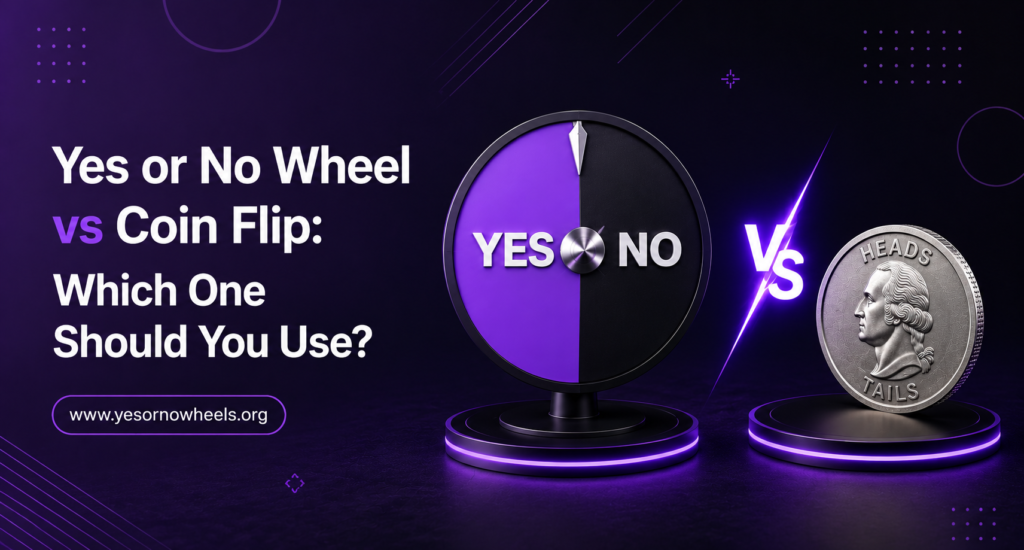
Levitt’s study used a real coin and asked about major life decisions, not a wheel and lunch orders — so it isn’t direct proof the wheel “predicts” anything. When looking at a yes or no wheel vs coin flip, the underlying mechanism it demonstrates — randomize the close call, then commit to the result — is exactly what a Yes or No Wheel offers on a smaller, everyday scale, with more flexibility than a coin (Maybe mode, custom odds, tracked history). The tool works the same way; it’s just applied to lower-stakes questions.
Where the Wheel Helps the Most
Situation
Why the Wheel Works Here
Two options feel equally good
There’s no logical winner to find — randomness ends the search instead of extending it
A group can’t agree
No individual has to “own” the choice, which removes the social friction
You keep re-deciding the same thing
The wheel gives the debate a hard stopping point
You’re not sure what you actually want
Your gut reaction to the result reveals the preference you hadn’t admitted
The decision is genuinely low-stakes
Perfect use case — fast resolution, minimal downside either way
How to Use the Yes or No Wheel Effectively
Write the question as an actual yes/no sentence, not a vague thought. Specificity does half the work.
Decide before you spin that you’ll honor the result. This is what makes it a real commitment device instead of just a suggestion.
Spin once. Don’t keep spinning until you get the answer you already wanted — that defeats the entire purpose.
Notice your immediate, pre-thought reaction the moment it lands. That reaction is often more honest than your reasoning.
If you feel truly neutral, go with the result. If you feel a flicker of relief or disappointment, trust that feeling over the wheel.
For decisions that don’t feel like a clean binary, switch to Yes/No/Maybe mode instead of forcing a false choice.
When Not to Rely on the Wheel
The wheel is built for close calls between two reasonable options — not for decisions where the stakes are uneven or the consequences fall on other people. Skip it for:
Medical, legal, or financial decisions that need actual expertise, not a random result
Anything irreversible where getting it wrong carries a real cost
Decisions that affect other people who haven’t agreed to let chance decide for them
Situations where you already know the right answer and are just avoiding it
Yes or No Wheel vs Deciding on Your Own
Factor
Deciding Alone
Using the Wheel
Time to reach a decision
Can stretch for minutes or hours
Seconds
Risk of endless re-arguing
High — no natural stopping point
Low — the spin is the stopping point
Reveals your true preference
Only through slow, conscious reflection
Often instantly, via your gut reaction
Best suited for
Complex, high-stakes decisions
Low-stakes, roughly equal choices
Frequently Asked Questions
How does a Yes or No Wheel actually work?
When you tap spin, the tool generates a random result immediately using a random number generator, then plays a spinning animation that visually lands on that pre-determined result. The animation is a presentation, not the decision-making step.
Can spinning a wheel really help me decide faster?
Yes, for close calls. It works by forcing a clearly stated question, cutting off endless internal debate, and giving you an instant reaction to respond to — which is usually faster than trying to reason your way to a “correct” answer between two roughly equal options.
Is it a healthy way to make decisions?
For low-stakes, everyday choices, yes — it saves mental energy and reduces overthinking. It’s not a substitute for careful thought on decisions involving health, money, legal matters, or other people’s wellbeing.
What’s the psychology behind why this works?
Your brain reacts emotionally to a result before you consciously evaluate it. That instant reaction — relief or disappointment — often reflects a preference you already had but hadn’t admitted to yourself.
Should I use it for something like quitting my job?
A large field study by economist Steven Levitt found people who let a coin flip guide major decisions like this were happier six months later, but that study involved real coins, follow-up surveys, and full commitment to the outcome. For anything at that scale, treat a wheel as one input to a bigger conversation with yourself, not the final word.
What’s the difference between Yes/No mode and Yes/No/Maybe mode?
Yes/No mode forces a hard binary result. Yes/No/Maybe adds a third outcome for situations where a genuine “not yet” or “undecided” is a fair answer — something a two-sided coin can never offer.
Bottom Line
A Yes or No Wheel doesn’t work because it’s random — flipping a mental coin in your head is random too. It works because it externalizes the decision, gives your indecision a hard stopping point, and hands you an instant emotional reaction to learn from. Used on the right kind of decision — low-stakes, roughly equal, dragging on far longer than it should — it turns minutes of circling into seconds of clarity.
SEO Notes for Publishing
Primary keyword: how the yes or no wheel helps you make quick decisions
Secondary keywords: yes or no wheel, quick decision maker, random decision maker, decision fatigue, analysis paralysis, how to make decisions faster
Suggested meta description: How does a Yes or No Wheel actually speed up decisions? A look at the psychology, a real 20,000-person study, and exactly when (and when not) to use one.