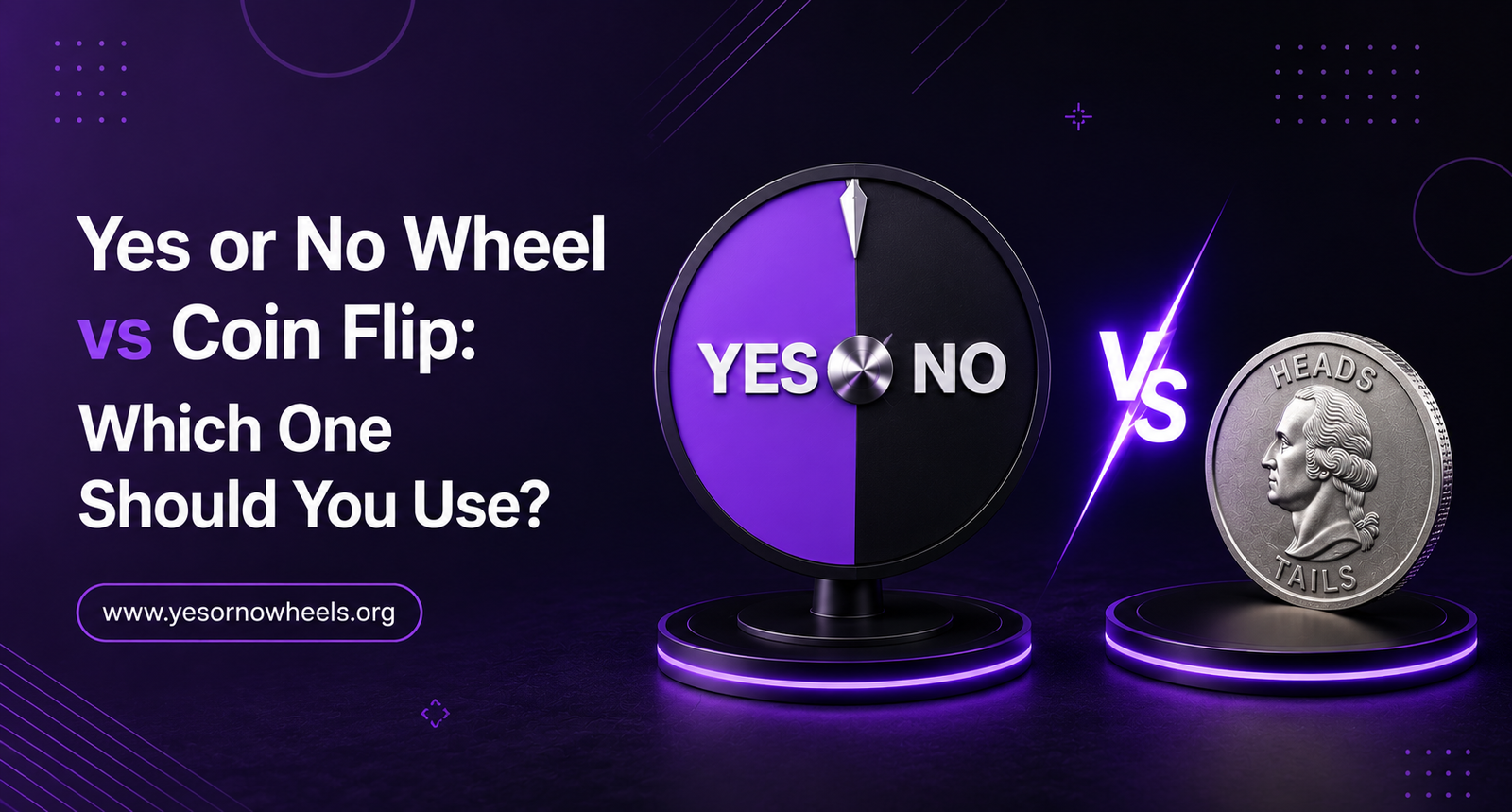
Yes or No Wheel vs Coin Flip: Which One Should You Use?
When you’re stuck between two equally good options, overthinking can make even simple decisions feel difficult. Tools like a coin flip and a Yes or No Wheel help break the deadlock by providing a random choice. While both seem similar, they create different experiences and aren’t always equally suited to every decision. This guide compares how each works, when to use them, and explores whether a coin flip is truly a fair 50/50 decision-maker based on published research.
Quick AnswerUse a coin flipwhen you want the fastest, most familiar, zero-setup answer — first turn in a game, a tiny disagreement, an instant tiebreaker.Use a Yes or No Wheelwhen the question is more open-ended, a group is watching, or you want the option to add a “Maybe” instead of forcing a hard binary. Both are random. Neither is “smarter.” The right tool depends on the moment, not the math.
What Exactly Are We Comparing?
The Coin Flip
The coin flip is probably the oldest random decision tool still in daily use. Assign heads to one option, tails to the other, toss the coin, and let physics settle the argument. Ancient civilizations used coins for exactly this reason — it’s fast, it needs no explanation, and everyone already trusts the format. A digital coin flip app just recreates that same experience on a screen, usually with a spinning coin animation and an instant result.
The Yes or No Wheel
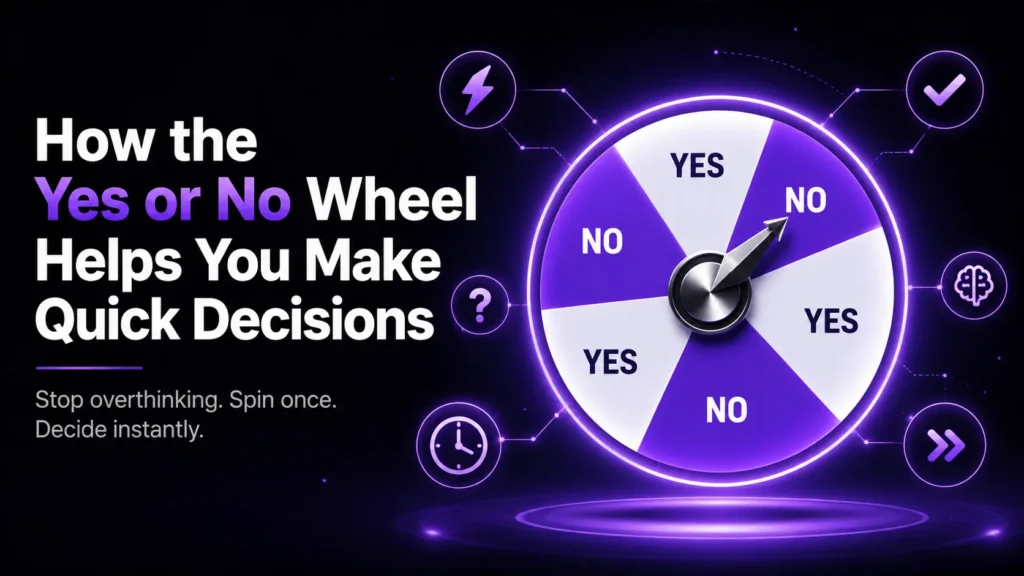
A Yes or No Wheel is a browser-based spinner wheel split into colored segments, most commonly “Yes” and “No,” sometimes with a third “Maybe” wedge. You type your question, tap spin, watch the wheel slow down, and it lands on your answer. Instead of physical mechanics, it’s powered by a random letter generator running in the background — the visual spin is really just a presentation layer on top of that number.
Yes or No Wheel vs Coin Flip: Side-by-Side Comparison
Factor
Coin Flip
Yes or No Wheel
Speed
Instant — under 2 seconds
A few seconds of spin animation
Setup needed
None (or a physical coin)
Type your question first
Outcomes
Fixed at two: heads or tails
Two or three (Yes / No / Maybe), sometimes custom labels
Randomness source
Physical toss mechanics
Software random number generator
Group appeal
Good, but over almost instantly
Stronger — everyone watches the spin build to a stop
Customization
None
Odds, colors, sounds, extra options
Offline use
Yes, with a physical coin
No, needs a device and connection
Best for
Quick, literal, two-sided calls
Open-ended “should I” questions and shared decisions
Is a Coin Flip Really 50/50? What the Research Actually Found
Here’s the part most “wheel vs coin” comparisons never mention: a coin flip is not perfectly random.
Back in 2007, Stanford statistician Persi Diaconis and his colleagues built a physics model of a tossed coin and predicted something counterintuitive — that a flipped coin is slightly more likely to land on the same side it started on. Their math put the bias at around 51%.
For years that was just a theory. Then, in 2023, a team of researchers put it to the test at scale. They recruited volunteers who performed350,757 individual coin tossesusing 46 different coins from around the world, and tracked which side was up before each toss versus which side it landed on. The result matched the 2007 prediction almost exactly: coins landed on their starting side50.8% of the timeinstead of a clean 50%.
That half a percentage point sounds trivial, and for a single decision, it is. You will never notice it choosing between takeout or cooking dinner. But it does settle an interesting question: a physical coin flip isn’t governed purely by chance — it’s governed by physics, and physics has a slight, measurable preference.
Why This Matters
If you want a truly unbiased 50/50 split with zero physical influence, a digital tool using a proper random number generator technically edges out a physical coin toss. The gap is tiny, but it’s real, and it’s backed by peer-reviewed data — not just a claim on a spinner website.
Is a Digital Wheel More “Random” Than a Coin?
A Yes or No Wheel doesn’t actually decide anything by watching where a spinning dial slows down, even though that’s what it looks like. Under the hood, most wheels generate a random number the instant you click spin, then animate the wheel to visually land on whatever that number already pointed to. The spin is a performance, not the mechanism.
That software-based approach sidesteps the physical quirks that affect a real coin: no starting-side bias, no wobble, no catching technique, no worn edges from years of pocket change. As long as the underlying number generator is properly built, every spin the wheel has an equal, independent chance — which is the one area where a well-made digital wheel can technically outperform a physical coin toss on pure statistical fairness.
That said, for everyday decisions, this difference is more of an interesting fact than a practical reason to choose one tool over the other. Nobody has ever lost sleep over a 0.8% bias in what to have for lunch.
When a Coin Flip Is the Better Choice
You need an answer in the next three seconds, not the next ten
The convention itself matters — first turn, choosing sides, a classic heads-or-tails call
You don’t have a device, or you’d rather not open an app for something this small
The decision genuinely has exactly two options, no middle ground needed
You want something universally understood without any explanation
When a Yes or No Wheel Is the Better Choice
The question is phrased more like a real question — “should I go,” “should we order pizza,” “should I message them”
A group needs to watch the outcome together, like in a classroom or a team meeting
A flat yes/no feels too rigid and a “Maybe” option would be genuinely useful
You want to track a history of past decisions or adjust the odds for a specific scenario
You’d rather have a small moment of anticipation than an instant, forgettable result
The Psychology Trick Both Tools Reveal
Here’s something worth trying the next time you use either tool: pay attention to how you feel in the half-second right after the result appears, before you’ve had time to think about it.
If the coin lands on “yes” and you feel a flicker of relief, that’s a signal your actual preference was yes all along, even if you weren’t ready to admit it. If it lands on “yes” and you feel a flicker of disappointment, your gut was actually leaning no. This isn’t magic — it’s a simple way to surface a preference your conscious mind has been avoiding because neither option felt clearly “better” on paper.
This is arguably the most useful thing either tool does. The random result itself is almost beside the point. What matters is your reaction to it.
Why We Even Need Tools Like This
You’ll often see the claim that the average adult makes around 35,000 decisions a day. It’s repeated constantly, but it’s worth being honest about where it comes from: no one has ever traced it back to a peer-reviewed study, and it appears to have started as an informal estimate that got quoted so often it turned into a “fact.” So treat that specific number with a healthy amount of skepticism.
What is well documented is the underlying phenomenon. A Cornell University study on everyday choices found people make an average of226.7 food-related decisions a dayalone — and when asked to guess that number themselves, participants estimated just 14.4. In other words, most of the small decisions draining your mental energy are ones you don’t even register as decisions. Separate research on judges reviewing parole cases found the rate of favorable rulings dropped steadily through a work session and jumped back up after a break, a pattern widely cited as evidence that decision-making quality genuinely declines with repeated use.
Put together, this is the real case for tools like a coin flip or a Yes or No Wheel. They’re not about the specific answer. They’re about refusing to spend real mental energy on a choice that doesn’t deserve it, so you have more left over for the ones that do.
Bonus Round: Wheel vs Coin vs Magic 8-Ball
Since we’re comparing random decision tools, it’s worth placing the classic Magic 8-Ball in the lineup too, since it’s the third tool people reach for.
Tool
Possible Outcomes
Feels Best For
Coin Flip
2 (fixed)
Instant, literal binary calls
Yes or No Wheel
2–3+, customizable
Open-ended questions, group settings
Magic 8-Ball
20 vague phrases
Novelty and nostalgia, less precise
The 8-Ball is fun, but it’s built for ambiguity — answers like “reply hazy, try again” are designed to dodge a clear result. If you actually want an answer, the coin and the wheel are the more useful tools of the three.
Final Verdict: Which One Should You Actually Use?
Your Situation
Recommended Tool
Deciding who goes first in a game
Coin Flip
Settling a quick disagreement with a friend
Coin Flip
“Should I text them / go out / try this?”
Yes or No Wheel
Making a decision in front of a class or team
Yes or No Wheel
You want a “Maybe” as a real option
Yes or No Wheel
No internet access, or you just want it over with
Coin Flip
Using the result to check your gut reaction
Either — the reaction matters more than the tool
Neither tool is objectively “better.” Statistically, they’re both close enough to random that it doesn’t matter for real life — the 0.8% coin bias is a fun fact, not a reason to change your habits. The real difference is experience: a coin flip is quick and quiet, a Yes or No Wheel is visual and social. Pick based on the moment you’re actually in.
Frequently Asked Questions
Is a coin flip actually 50/50?
Not exactly. A large-scale 2023 study of over 350,000 real coin tosses confirmed a small “same-side bias” of about 50.8%, meaning a coin is slightly more likely to land on whichever side was facing up before the toss. It’s too small to matter for everyday decisions, but it’s not a perfect 50/50.
Is a Yes or No Wheel more random than a coin flip?
Technically, a well-built digital wheel can be more statistically fair, since it relies on a random number generator with no physical bias, wobble, or starting-side effect. A coin’s randomness depends on the toss itself, which is subject to small physical influences.
Can I use these tools for big life decisions?
They’re best suited to low-stakes, roughly equal choices. For bigger decisions, treat the result as a way to reveal your gut reaction rather than a final answer — if the outcome disappoints you, that tells you something the outcome itself doesn’t.
What does a Yes, No, Maybe wheel do that a coin can’t?
A physical coin only has two sides, so it’s locked into two outcomes. A digital wheel can add a third “Maybe” segment, adjust the odds, or use custom labels entirely — flexibility a coin simply doesn’t have.
Which is faster, a coin flip or a Yes or No Wheel?
A coin flip wins on raw speed — an instant toss or tap versus a few seconds of spin animation. The wheel trades that speed for a bit of anticipation, which tends to matter more in group settings.
Why do I feel relieved or disappointed after seeing the result?
This is a well-known decision-psychology effect. Your brain compares the random result to a preference you already had but hadn’t consciously admitted. Relief usually means the result matched what you actually wanted; disappointment usually means it didn’t.
Bottom Line
A coin flip and a Yes or No Wheel solve the same basic problem — they both hand a small, low-stakes decision over to chance so you can stop circling it. The coin is faster and needs nothing but two seconds and a bit of change. The wheel is slower but more visual, more flexible, and better when people are watching. Neither is scientifically “smarter” than the other, even with the coin’s tiny measured bias. Use whichever one fits the moment, pay attention to how the result makes you feel, and get back to your day.